
French Magazine Carnets d'Aventures reviewed the Ouroboros CR back in January. The original story is available in French HERE or in English below.
In their review, Carnets d'Aventures found the Ouroboros to be a genuinely compelling bridge between gravel and mountain biking. They noted that the 40mm of front suspension and dropper post weren’t gimmicks, but meaningful additions that reduced fatigue, improved control, and opened up rougher terrain without sacrificing efficiency on pavement. What stood out most was its balance — capable on demanding backcountry tracks, yet still lively and practical for long mixed-surface days. Rather than feeling like a niche experiment, Carnets d’Aventure described it as a bike that quietly makes a strong case for suspended gravel done right.
66 · ADVENTURE JOURNALS · No. 82
SUSPENDED GRAVEL BIKEPACKING
There is a question even more divisive than pain au chocolat versus chocolatine in the cycling world: is gravel a discipline in its own right, or just a reinvention of 1990s mountain biking? So when the iconic Canadian brand releases a suspended gravel bike, it really throws a stone into the pond. Immediately, Jean-Michel Saitou – administrator of the Facebook group “It Was Better Before” – rushes to his favorite social network to proclaim the end of the gravel spirit.
But Kona is clever. They called this bike Ouroboros. According to Wikipedia:
Ouroboros, masculine, invariable (Mythology): A serpent or dragon that bites its own tail. It symbolizes the eternal cycle, the return to the initial state.
Brilliant. Kona is trolling us with subtlety. Instead of denying the loop, they embrace it right under the noses of the killjoys who don’t like going in circles. Checkmate, and kisses to Jean-Michel.
A TOWERING FEUD
Let’s add some context. In the 2010s, bicycle travel underwent a schism. On one side, the gravel crew and its holy trinity: Rapha outfit, KOMs on Strava, and a photo of the setup on Instagram. With so many Anglicisms, their trips are the only ones deemed worthy of the honorary title bikepacking. In short: traveling fast and in style.
On the other side, cycle tourists in sandals and socks – comfort before dignity – astride their indestructible 18-kg steed (empty, of course), bristling with panniers as aerodynamic as a wardrobe. They prefer malty breaks to the intoxication of accumulated kilometers. Gastronomy and scenery rather than protein energy bars swallowed head down on the bars. Less glamorous? I’m barely exaggerating.
These two clans eye each other like wary dogs, yet they share the same desire for elsewhere, as we regularly write in these pages. Remember, in The Anti-Manual of Bicycle Travel, I was already poking fun at this turf war:
Should I differentiate cycle touring, bikepacking, gravel, MTB…? Of course you should! Choose a clan and stick to it. Adopt its style and codes so you’ll be recognized by your peers. If you happen to cross paths with a member of the opposing clan, barely acknowledge them. Worse, if you must speak to them, immediately make it clear that their choice is questionable while looking down on their miserable mount. Judge them with limitless bad faith, and above all, don’t go see whether the grass is greener elsewhere.
MEA CULPA
Let he who is without sin cast the first stone. At first, I cheerfully criticized the promise of gravel: being able to leave the road… provided you’re shaken like a plum tree as soon as the gravel size increases. Dirt is never truly smooth without its anthropogenic varnish: sacred asphalt. And I was doing just like them on my refurbished old 1990s Scott.
But in order not to be as rigid as my frame, I mellowed out. An attempt not to become a grumpy old man? Probably. Or maybe because I don’t identify with any clan. A cycling orphan, in a way. People even mocked my old Scott, supposedly only good for going to buy bread. The insult. I take it philosophically, never missing a bakery on my travels.
If we’re talking symbolism, Saint Honoré – patron saint of bakers and pastry chefs – suits me better than the Ouroboros. But I digress.
FORTY MILLIMETERS
That’s the size of a cocktail sausage. A suspension travel that would make a modern mountain biker smile, perched on 100 to 200 mm of suspension. Yet these forty millimeters are the epicenter of the controversy: are they just there to help me through my midlife crisis?
To paraphrase the famous social-media refrain: is it gravel or isn’t it gravel? With or without gravel, we’re venturing onto slippery ground. To know for sure, I had to try this bike before the gravel police intervened (aka Jean-Michel).
I naturally started riding the Ouroboros around home, getting familiar with this new bike, its position and behavior, on tracks I know so well I could name every single pebble. A local laboratory where I could ride the same route repeatedly with two different bikes, avoiding what I call the Apple effect: that cognitive bias that makes you say “it’s a revolution” because you spent a month’s salary on the latest model, when objectively it’s just another phone.
Good heavens, the verdict was clear! With the Kona, those same pebbles felt smoother, less angular, even fewer. A striking difference, like switching from high heels to espadrilles. And if nostalgia for compressed vertebrae and jelly arms kicked in, I just had to lock out the fork to realize how effective it is: you don’t change bikes, you change planets.
A PLAY MACHINE
The fork isn’t alone. Its accomplice: the dropper seatpost. A detail that’s not a detail at all. Once you try it, you wonder how you ever lived without it. Downhill, saddle lowered, magic happens: shoulders relax, neck angle becomes more natural, and handling improves. You stop enduring the terrain and start playing with it.
Feeling confident, I found myself exploring areas around home that I had previously ignored: trails too bland to enjoy on an MTB, but too brutal to survive on a rigid gravel bike. The Ouroboros shone there, in that in-between.
A FORGIVING MACHINE
More comfort means more fun, but above all, more safety… or more speed, depending on your survival instinct. Intoxicated by the unexpected smoothness of the ground, I started to feel invincible… until I remembered my travel crashes – thankfully minor – which all share the same script: rough track, end-of-day fatigue, bad line choice, and bang.
The Ouroboros’ suspension forgives. It erases the small braking mistake that would normally send me eating dust. It whispers: “Don’t worry, I’ve got this.” (Not like when you’ve had three drinks in each arm.)
THE BIG TEST
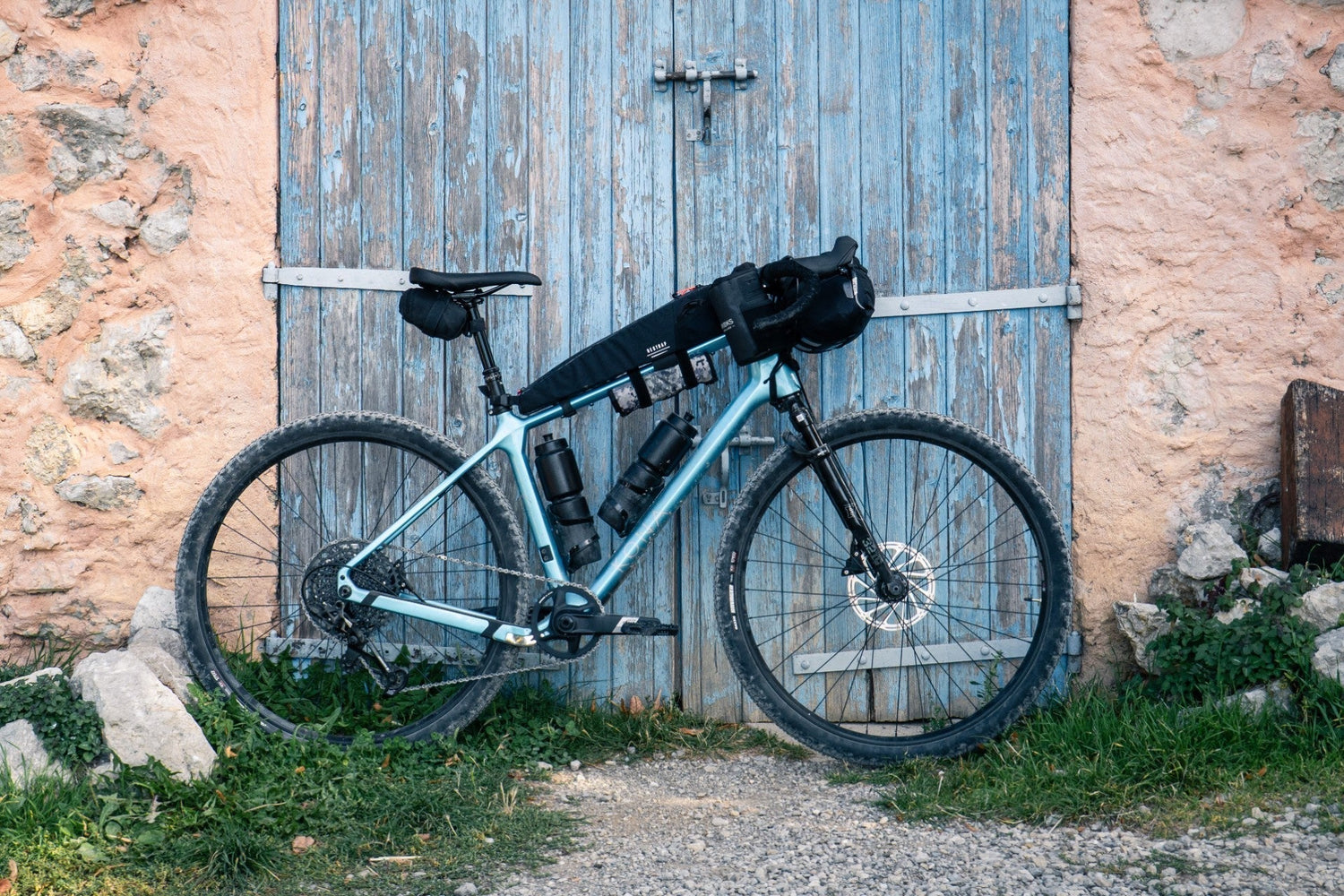
Time to validate this in real conditions. Destination: the Southern Alps. The plan? Freedom. I had spotted a few tracks, but wanted to let my mood decide and the bike do the rest. Every time a dirt track appeared, it felt like the bike was begging me to take it.
The result: days spent largely off-road, including several sections with gravel bordering category 5 – on the gravel Richter scale, from 1 (castle driveway) to 5 (dry riverbed). When the guidebook warned, “MTB-style section, lots of rocks, brakes on,” I went in calmly. Was it easy? No. But it wasn’t torture either.
And when it came time to climb the endless Tinée valley – a long false flat of about forty kilometers – the Ouroboros didn’t let me down. A true adventurer. On an MTB, stuck to the tarmac, I would have had time to question the meaning of life – and maybe even find the answer.
That’s Kona’s masterstroke: gravel geometry and cockpit for efficiency, sprinkled with a touch of MTB comfort for fun when the asphalt ends. A perfectly placed slider, a clever blend that makes you miss neither trail nor road. Put differently: I’ve rarely had so much fun across all surfaces combined.
THE N+1 PROBLEM
No, we’re not talking about your boss, but about the cyclist’s fundamental theorem: the ideal number of bikes to own is always N (your current number) + 1. A law seemingly as immutable as gravity.
Is the Kona Ouroboros the exception that proves the rule? The quest for the do-it-all bike usually ends with a machine that does everything… poorly. The Swiss-army-knife paradox: it cuts sausage badly and tightens screws poorly – but it helps out (and opens a bottle of red!).
Is the versatile bike also a chimera? In mythology, the chimera has a serpent’s tail… just like our Ouroboros biting its own. Coincidence? Either way, the compromise works here: instead of adding a bike to the garage, it can – in my case – replace two. The opposite of N+1: N-1.
NOSTRADAMUS
So, is suspended gravel the future? Will fully rigid bikes soon be as outdated as using a Minitel? Don’t expect me to play prophet. I’m not an influencer, and even less a medium. In 2001, I invested all my savings in a MiniDisc player, convinced it was the future. The iPod had just come out, and soon the whole world was carrying thousands of songs in their pockets.
To find your bike, shouldn’t you free yourself from marketing, trends, and my predictions – about as reliable as a two-week weather forecast?
THE BEST OF ALL WORLDS
Let the purists grumble about innovations that shake their beliefs. The Kona Ouroboros won’t escape it. Let’s return instead to what Wikipedia says about our mythical serpent:
The circular form of the image has led to another interpretation […]. It thus signifies the union of two opposing principles: heaven and earth, good and evil, day and night, the Chinese Yin and Yang, and all the values these opposites carry.
What if that’s the magic of the Ouroboros? Reuniting two worlds that keep drifting apart. Lycra-clad, shaved-leg riders versus muddy, baggy-shorts wearers. Rigid purists versus suspension technocrats.
This bike is an open letter to those who no longer want to choose. To those who refuse to be boxed in – probably because they don’t fit. To those who ride for pleasure, without codes or constraints. The Ouroboros put a smile on my face as wide as its handlebars, and that’s all that matters.